
Welcome to DermaTopics.dk a site maintaied soly with the purpos on securing availability and ease of use of tool and knowledge for other dermatology medical specialists. SO, please, if you are not a dermatology medical specialist use the information we provide with great caution – it is simply meant to support other specialist and will under no circumstance provide sufficient information for any one to draw any medical or treament wise decisions/conclusions.
SALT Score
The severity of Alopecia Areata (AA) is typically measured with the Severity of ALopecia Tool (SALT) Score1,2 . The SALT Score is computed by measuring the percentage of hair loss in each of the 4 areas of the scalp — the right profile (accounting for 18% of the total scalp area), the left profile (18%), the vertex (40%), and the posterior (24%), see also figure 4 below. By adding the total procentage of hair loss for each region multiplied by the regions relative area, one achieves a composite total score ie the SALT Score. Hair regrowth is reflected by a decrease in the SALT score (eg, complete hair regrowth would confer a SALT score of 0). Below you will find a simple tool that does the SALT SCORE calculation based on hair loss in each of the above mentioned regions.
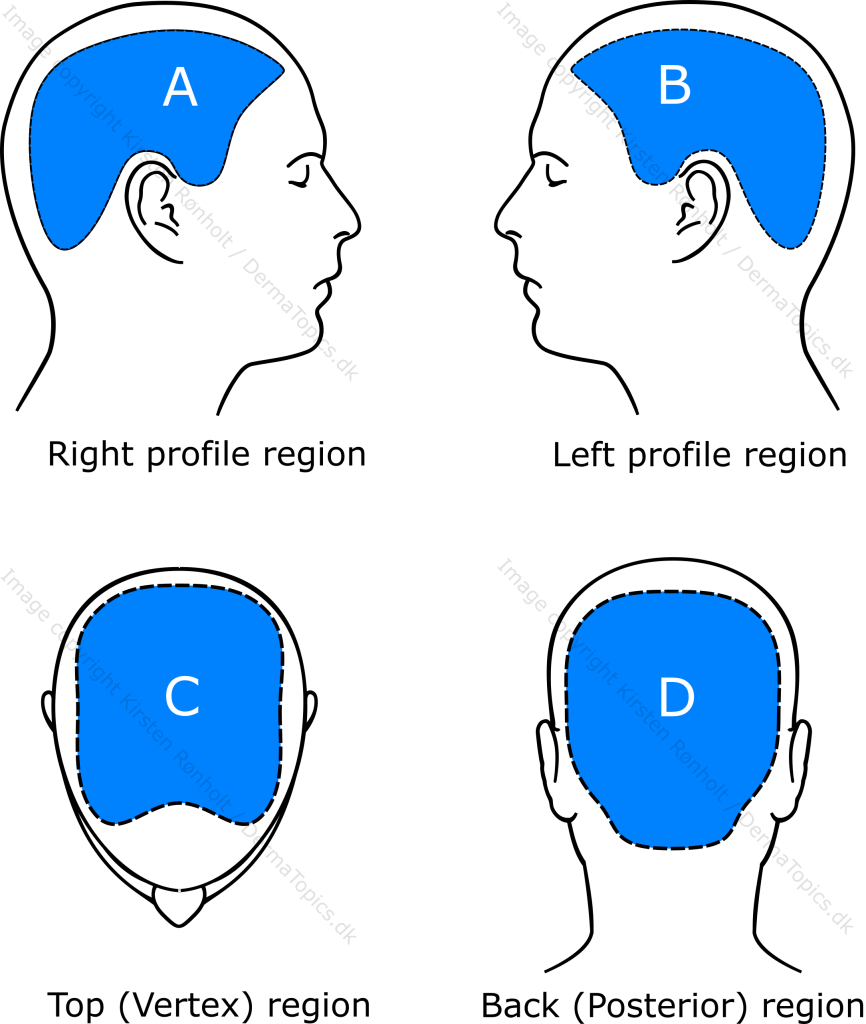
Image copyright: Kirsten Rønholt site author
References:
ClinRO-score
ClinRO (Clinician-Reported Outcomes):
Used by dermatologists to assess visible changes in eyebrows and eyelashes.
Alopecia areata affects more than just scalp hair. Loss of eyebrows or eyelashes can significantly impact appearance, function, and quality of life. A reliable scoring method is essential— especially when evaluating new treatments.
In 2020, an international research team developed a new scoring method1 that makes it easier and more accurate to assess eyebrows and eyelashes in alopecia areata. Until now, most assessment methods focused mainly on scalp hair loss, leaving important aspects of the disease under-measured.
ClinRO Measure for Eyebrow Hair Loss™
Examine both eyebrows from two feet away and select the best response below:
- The eyebrows have full coverage and no areas of hair loss
- There are minimal gaps in eyebrow hair and distribution is even
- There are significant gaps in eyebrow hair or distribution is not even
- No notable eyebrow hair
ClinRO Measure for Eyelash Hair Loss™
Examine the upper and lower eyelashes of both eyes and select the best response option below:
- The eyelashes form a continuous line along the eyelids on both eyes
- There are minimal gaps and the eyelashes are evenly spaced along the eyelids on both eyes
- There are significant gaps along the eyelids or the eyelashes are not evenly spaced along the eyelids
- No notable eyelashes
Reference:
DLQI
Dermatology Life Quality Index (DLQI)
The Dermatology Life Quality Index (DLQI) measures the health-related quality of life of adult patients with a skin disease. Below you will find the questionnaire in an in an easy to use online-form format. Following full completion of the form, the tool will calculate the resulting DLQI.
About the author
The author of this page is dermatoligist Kirsten Rønholt from Denmark. This page will be updated only as needed – in the meantime please consult my/our linkedIn profile Kirsten Rønholt.